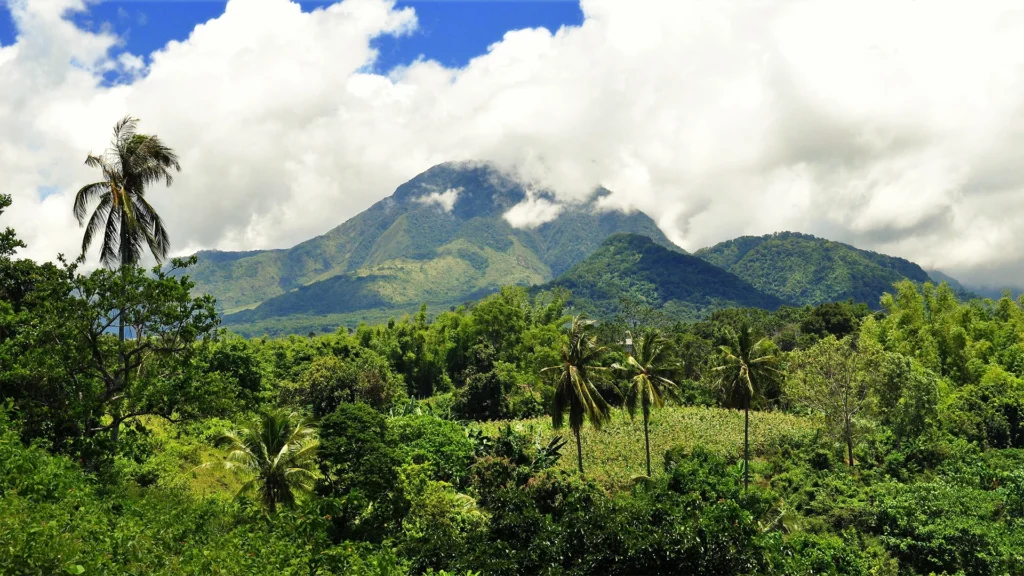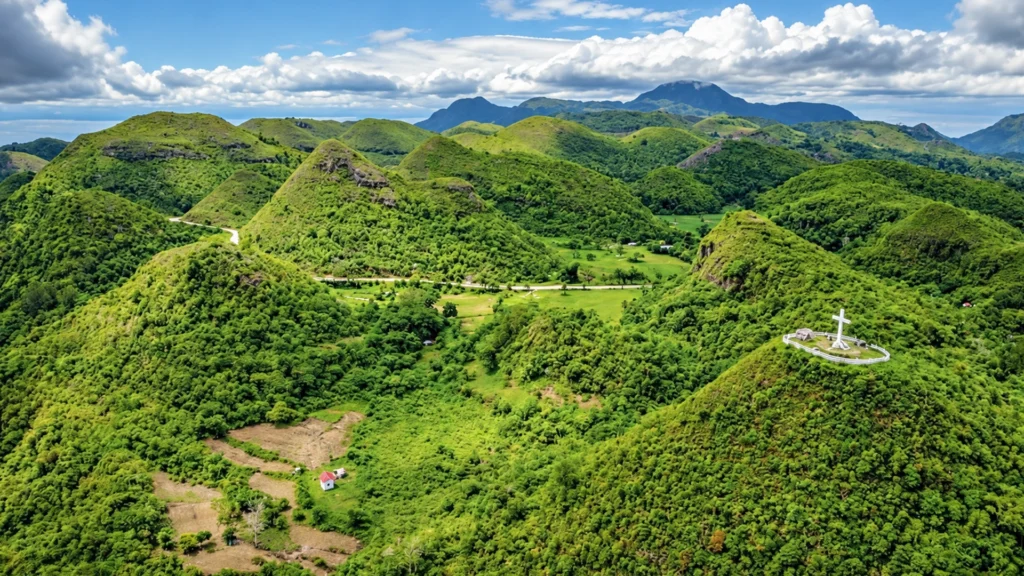
Hinakpan Hills brings a different shape to the mountain landscapes of Negros Oriental. In the uplands of Guihulngan, individual hills rise across the countryside, their rounded and sometimes pointed profiles creating a succession of distinct forms. The eye moves from one to another, following the spaces between them as much as the hills themselves.
Often described as the Chocolate Hills of Negros, Hinakpan is more interesting when considered on its own terms. Its appeal combines an unusual landscape with the experience of a rural community and a hilltop pilgrimage route. It is a place to look across the terrain, walk towards a viewpoint and discover how scenery and local life occupy the same ground.
A Landscape of Individual Hills
The comparison with Bohol helps explain Hinakpan’s initial attraction: repeated hill forms give the landscape a recognisable rhythm. Yet the hills vary in shape, with some more rounded and others tapering towards pointed tops. Their differences give the view its character.
From an elevated position, that pattern becomes easier to appreciate. Nearer hills define the foreground while more distant forms overlap, creating depth across the panorama. A photograph can convey the arrangement, but looking slowly across it allows individual features to emerge.
Hinakpan also offers a contrast with the forest enclosed experience of a larger mountain trek. Here, the principal attraction is the visible organisation of the land. The spaces between the hills, the surrounding countryside and the changing horizon are all part of the scene.
Monte Calvario: A View with Another Meaning
One documented way to appreciate Hinakpan is from Monte Calvario, a hilltop reached by a route containing Stations of the Cross. It serves both as a viewing location and as a place of Christian devotion.
That gives the ascent more than one meaning. A visitor may follow it for the panorama, while a pilgrim approaches it as a sequence of prayer and reflection. Published accounts describe steps leading upwards, religious stations along the way and a church visible in the valley below.
The shared setting adds a human dimension to the landscape. The viewpoint is part of a place people use for purposes extending beyond sightseeing. Visitors can enjoy its outlook while allowing space for worshippers and respecting the character of the route.
Local Memory in the Name
Hinakpan is also known as the Mystical Hills. The name invites curiosity, although it should not be treated as evidence of a particular legend or supernatural tradition.
A local account published in SunStar offers another connection to the landscape. It relates an explanation from elders that Hinakpan takes its name from the takpan tree, described as a hard timber tree once abundant in the area.
This is an account of local memory rather than a verified botanical history. Nevertheless, it introduces a worthwhile perspective: place names can preserve associations with vegetation and earlier surroundings. The hills are a visual attraction today, but the name encourages interest in how people have understood and described the area over time.
Looking Closely at the Countryside
The village setting helps distinguish Hinakpan from a viewpoint visited only for a photograph. Travel accounts place the hills around the upland community along the route linking Guihulngan with Isabela on the other side of Negros.
The journey therefore introduces the wider interior of the island as well as the formations themselves. Roads, buildings and cultivated ground provide a sense of scale and remind visitors that the panorama belongs to an inhabited countryside.
For photography, the attraction lies in finding a position that shows both the repeated hill shapes and their surroundings. Time of day and visibility change the appearance of the view, making an unhurried visit more rewarding than a single brief stop.
Another Perspective on Negros Oriental
Hinakpan combines interests that may appeal to different visitors. The hill formations provide the immediate visual attraction. The ascent to Monte Calvario adds walking, while its religious use and the story of the place name introduce cultural perspectives.
Its broader value is the opportunity to experience a different part of Negros Oriental. A journey here extends exploration into Guihulngan’s uplands and reveals a landscape with a character distinct from the coast, forested summits or cloud viewpoints elsewhere in the province.
For someone considering a longer stay in the region, such variety matters. Hinakpan offers an excursion centred on observation and curiosity, with several reasons to linger beyond the first photograph.