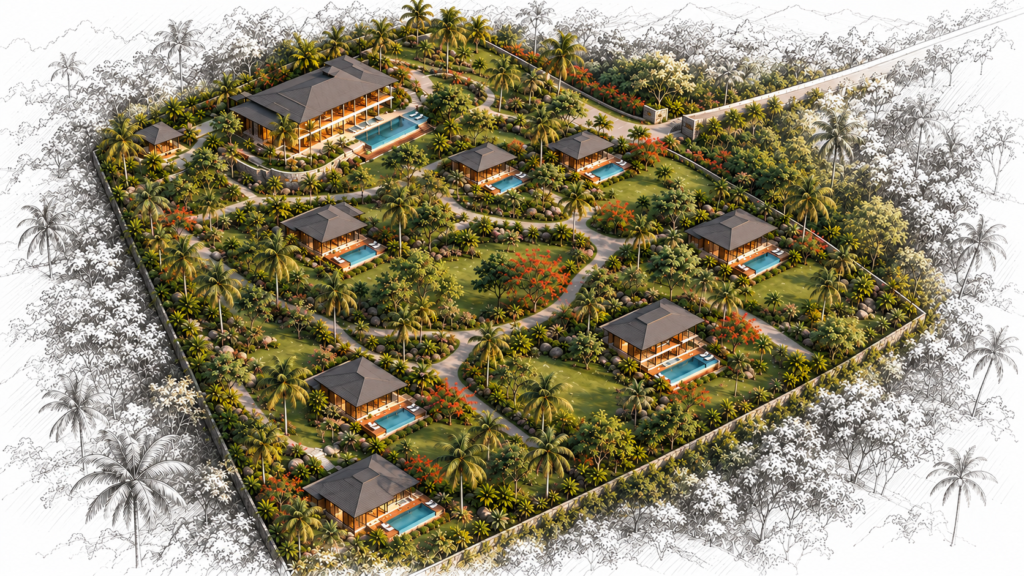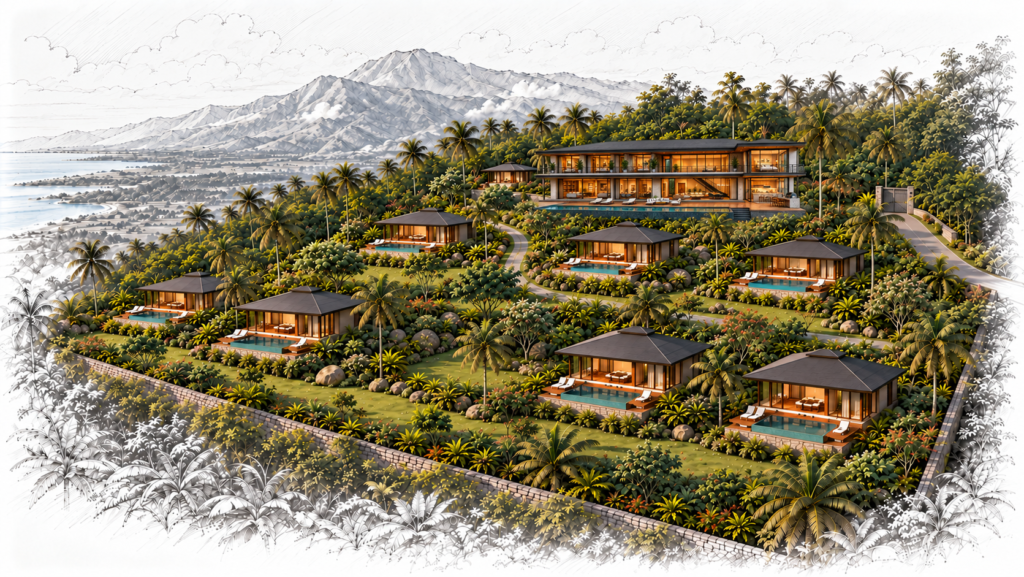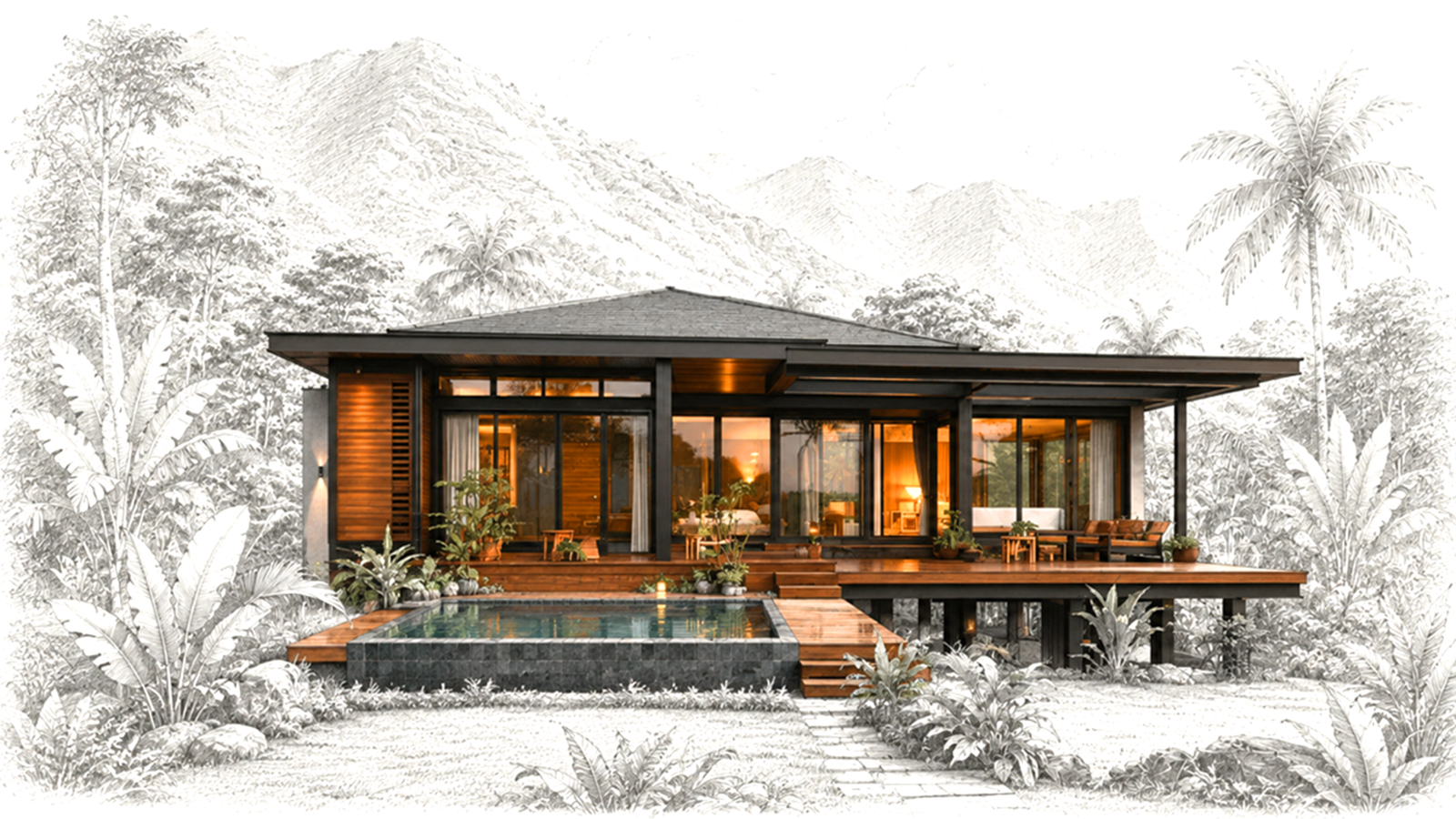
A masterplan needs to provide a clear sense of direction, but it should not become a constraint on the development it is intended to guide. Residential preferences change, hospitality markets evolve and practical experience often reveals opportunities that were not apparent during the earliest planning stages.
For Tala, this presents an important consideration. The ambition is to create an integrated residential and hospitality community, but its development need not depend on every component being introduced at once.
A carefully considered approach to growth offers the opportunity to establish a recognisable identity from the outset while retaining the flexibility to respond to changing requirements.
Establishing a Vision That Can Grow
One of the advantages of a coherent masterplan is that it provides a framework for making decisions over time.
Without that framework, individual buildings and facilities may be developed in response to immediate opportunities, gradually producing a collection of unrelated spaces.
At Tala, the objective is to establish a consistent relationship between residential accommodation, hospitality, shared facilities and the surrounding landscape.
This does not require every detail to be determined in advance. Instead, the masterplan can identify the principles that should remain consistent, such as the overall architectural character, the relationship between private and communal areas and the importance of maintaining an attractive environment.
Within those principles, individual components can evolve as the development progresses.
The distinction is between having a clear vision and imposing a fixed blueprint that cannot accommodate new information.
The Value of Progressive Development
Introducing a development progressively can offer practical advantages, particularly when residential and hospitality uses are intended to complement one another.
An initial collection of accommodation and supporting facilities can establish the character of a place without requiring the entire development to be completed simultaneously.
Subsequent additions can then respond to experience, including how residents use communal areas, which accommodation arrangements appeal to visitors and what operational requirements emerge.
This approach also provides opportunities to refine the balance between private residences, visitor accommodation and shared facilities.
However, progressive development introduces responsibilities of its own.
Each stage needs to function effectively rather than depend on facilities that may only become available later. Residents and guests should be able to enjoy a complete and comfortable experience within the parts of the development already operating.
For Tala, this suggests that each addition should contribute value to the existing community while supporting the wider masterplan.
Protecting the Experience During Growth
An expanding development must consider the people already using it.
Construction activity, changes to access routes and the introduction of additional buildings can affect privacy, convenience and the atmosphere that originally attracted residents or visitors.
These effects are not necessarily reasons to avoid expansion. They are reasons to consider how growth can be accommodated with minimal unnecessary disruption.
At Tala, the relationship between established and future development areas will be particularly important.
A well organised masterplan can help maintain convenient access, protect the usefulness of existing communal spaces and preserve the character of landscaped areas as new components are introduced.
The same principle applies to infrastructure. Electricity, water, drainage, communications and access arrangements need to be considered with future requirements in mind, even where the initial development is relatively modest.
Planning for future capacity does not mean installing every possible system immediately. It means understanding how essential services could be expanded without repeatedly disrupting the existing community.
Learning from the People Who Use Tala
A development intended to serve visitors, occasional property owners and longer term residents must accommodate a range of expectations.
These expectations may also change over time.
A hospitality guest may value convenience and access to shared facilities, while a permanent resident may place greater emphasis on privacy, dependable services and comfortable everyday routines.
As Tala develops, feedback from these different audiences could provide useful guidance for future decisions.
Patterns of facility use, accommodation preferences and operational experience can help identify where additional investment in the physical development would be most valuable.
Importantly, responding to feedback should not mean changing direction whenever a new opportunity appears.
The masterplan needs sufficient flexibility to accommodate sensible improvements while retaining the qualities that make the development recognisable.
That balance between consistency and adaptability is central to creating a community capable of remaining relevant over many years.
Building for the Longer Term
The most useful masterplans are not necessarily those that predict every future requirement. They are those that establish a strong foundation for making good decisions as circumstances change.
For Tala, this means considering how individual components contribute to the wider development, how existing residents and visitors are affected by growth and how future additions can reinforce rather than dilute the original concept.
There is a commercial dimension to this thinking. A development that can respond to changing visitor preferences and residential requirements has more options than one whose configuration is fixed from the beginning.
There is also a personal dimension. Someone considering a property for occasional use today may be interested in how the wider community could develop over the next decade, particularly if longer stays or permanent residence become attractive later in life.
Neither perspective requires an ambitious construction programme or a promise of continuous expansion. What matters is confidence that future decisions will be considered within a consistent framework.
Tala’s long term opportunity lies in creating a community that feels complete at each stage of its development, while remaining capable of thoughtful evolution.
A successful masterplan should give the development room to grow without losing the qualities that made it worth creating in the first place.