When evaluating the long-term viability of a real estate investment, a professional must look beyond immediate market metrics and scrutinize the underlying administrative and governance architecture.
In emerging markets, institutional bottlenecks, slow permitting pipelines, and decentralized government offices frequently introduce severe project friction. For developers and business partners assessing the Visayas, the legislative landscape has undergone a profound structural shift that fundamentally de-risks assets located in Negros Oriental.
The signing into law of Republic Act No. 12000, known as the Negros Island Region (NIR) Act, represents a major milestone in administrative decentralization.
By unifying Negros Occidental, Negros Oriental, and Siquijor into a single, cohesive administrative region, this legislation addresses a long-standing structural inefficiency.
For Tala Residences in Dauin, the creation of the NIR is not merely a political footnoted change; it is a powerful economic catalyst that directly enhances project execution and long-term capital preservation.
Eliminating Cross-Island Red Tape
Historically, doing business on Negros Island meant operating under a fragmented administrative system.
The island was split down its central mountain range: Negros Occidental belonged to Region VI (Western Visayas) with its regional center in Iloilo, while Negros Oriental belonged to Region VII (Central Visayas) with its center in Cebu City.
This geographical division introduced substantial administrative friction for independent developers.
Processing land titling conversions, securing regional environmental clearances (ECCs), coordinating infrastructure connections, and navigating corporate compliance mandates required constant, time-consuming sea and land travel to Cebu.
This reliance on distant regional hubs frequently caused protracted bureaucratic delays, inflating soft costs and extending project delivery timelines.
Republic Act No. 12000 eliminates this systemic delay. By establishing a fully independent regional structure, the law mandates that critical government agencies open fully functioning regional offices directly on the island.
For partners in Tala Residences, this means that essential regulatory interfaces, including the Department of Environment and Natural Resources (DENR), the Department of Public Works and Highways (DPWH), and investment programming boards, are now localized right within the province. Bureaucratic processing is streamlined, administrative timelines are compressed, and the risk of regulatory delays is substantially minimized.
Direct Budgetary Allocations and Infrastructure Acceleration
Beyond administrative efficiency, the establishment of the NIR introduces a dedicated fiscal channel that accelerates infrastructure development. Previously, Negros Oriental had to compete with the massive economies of Cebu and Iloilo for national funding allocations.
Consequently, critical regional infrastructure projects, such as provincial road expansions, secondary airport upgrades, and utility grid reinforcements, were often secondary priorities.
Under a unified region, the NIR receives its own direct appropriations within the national General Appropriations Act (GAA). This independent fiscal stream ensures that infrastructure funding is retained and deployed locally to support regional economic integration.
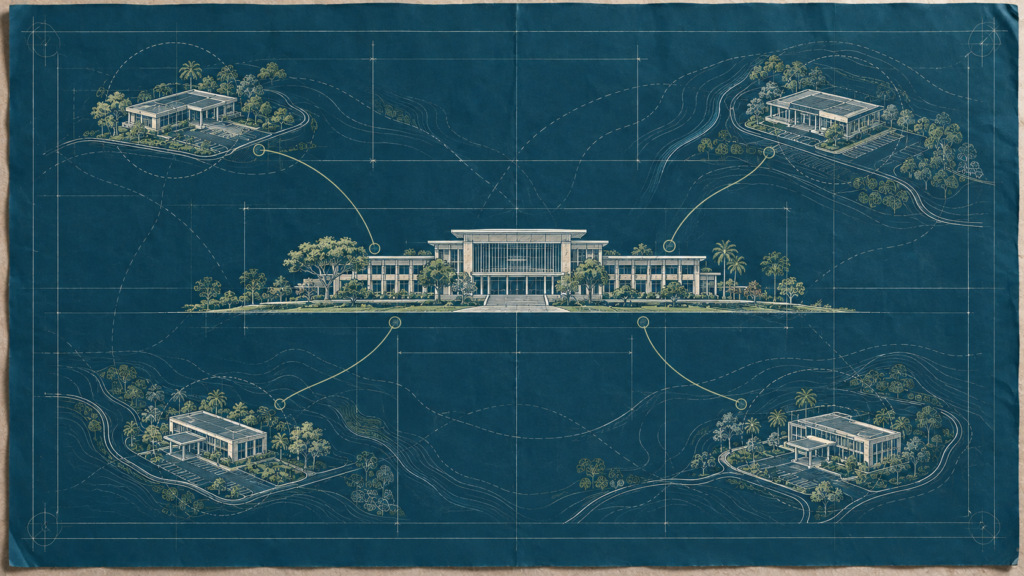
Crucially, Dumaguete City has been designated to host the Human Development, Infrastructure, and Industry/Labor clusters for the new regional government, bringing sixteen major regional offices directly to the city.
This concentration of administrative and infrastructural oversight just twenty minutes from the Tala Residences site ensures that public works, road networks, and utility maintenance are prioritized and executed with high efficiency.
Promoting Sustainable Real Estate Valorization
From an institutional investor’s perspective, administrative decentralization directly drives asset appreciation.
The economic history of the Philippines demonstrates that when a province transitions into a regional administrative capital, it triggers a predictable influx of professional talent, commercial enterprises, and targeted public expenditure.
The corporate growth cycles follow an integrated sequence: localized governance yields faster permitting and structural approvals; direct GAA funding allocations accelerate paved regional road networks; and hosting regional cluster head offices draws an influx of high-earning capital to the provincial core.
More importantly, the timing of the NIR Act aligns with a broader national effort to formalize and stabilize property markets.
Alongside Republic Act No. 12000, the implementation of uniform valuation frameworks under the Real Property Valuation and Assessment Reform Act (RPVARA) brings unprecedented transparency and accuracy to land values.
This legislative combination eliminates arbitrary local assessments and establishes a secure, internationally aligned environment for property ownership. Ultimately, the creation of the Negros Island Region alters the investment risk profile of Dauin.
It replaces cross-island bureaucratic hurdles with localized, streamlined governance and dedicated infrastructure capital.
For strategic partners looking at Tala Residences, this macro-governance milestone provides an incredibly secure foundation: an elite, low-density hospitality asset positioned inside the country’s newest, most streamlined economic corridor.