When analyzing the financial landscape of Southeast Asia’s premium lifestyle destinations, the initial entry cost of land is only one variable in the equation.
For an independent developer or business partner, the far more critical vector is the legal tenure of the asset and how it dictates long-term capital preservation.
Contrasting mature cross-border ecosystems with emerging micro-markets reveals a profound valuation asymmetry.
Strip away local currency fluctuations and convert real estate values to a standardized metric, Price per Square Meter (psqm) in US Dollars (USD), and the economic thesis for Tala Residences in Dauin becomes clear.
Bali’s Saturated Leaseholds: A Compressing Runway
Bali remains the regional benchmark for lifestyle tourism, but its real estate mechanics present severe financial headwind for new capital.
In premium coastal pockets such as Canggu, Seminyak, or Berawa, raw land values routinely trade between $400 and $800 PPSQM, often spiking well past $1,700 psqm in highly densified zones.
To escape this compression, premium capital historically migrated inland to Ubud’s jungle ridges ($150 to $300 psqm) and Uluwatu’s clifftops ($300 to $600 psqm).
However, the core financial risk in Bali lies in its structural dependency on leasehold titles (Hak Sewa) rather than freehold ownership.
These prices generally buy a fixed 25-to-30-year lease. From an accounting standpoint, a leasehold is a wasting asset; its value mathematically degrades toward zero as the expiration date approaches.
Refinancing can be highly restricted, and extensions are priced at future, un-capped market rates.
Spending $300 psqm on a ridge plot in Uluwatu means the developer’s capital amortization schedule is intensely compressed, squeezing long-term rental yields and entirely eliminating the possibility of a permanent, multigenerational residential asset.
The Speculative Mid-Tier: Siargao and Panglao
Moving the analysis to the emerging islands of the Philippines introduces a structural advantage: the ability to secure freehold titles or highly stable, multi-decade commercial leases through institutional corporate vehicles.
Yet, the top two domestic destinations display localized price inflation that alters the risk-reward ratio.
In Siargao, land pricing has become intensely speculative, concentrated heavily along the Tourism Road corridor in General Luna.
Prime commercial beachfront land near Cloud 9 trades at approximately $440 psqm (₱25,000 psqm), while standard roadside commercial frontage averages $150 psqm (₱8,500 psqm). While inland pockets drop to $60–$100 psqm, independent builders must immediately dilute those land savings by sinking massive capital into off-grid utilities, power stabilization, and deep-well water filtration.
Panglao Island presents an even more institutionalized hurdle.
Driven by international airport access, the median land sale price across the island sits at $120 psqm(₱6,925 psqm).
However, premium, beach-accessible zones feature Bureau of Internal Revenue (BIR) zonal valuation floors of $840 psqm (₱47,840 psqm), with free-market titled transactions trending significantly higher.
Entering these markets at such an elevated baseline limits an independent developer’s capacity to build low-density configurations without over-leveraging the project’s financial foundations.
The Dauin Arbitrage: Capital Protection on the Ridge
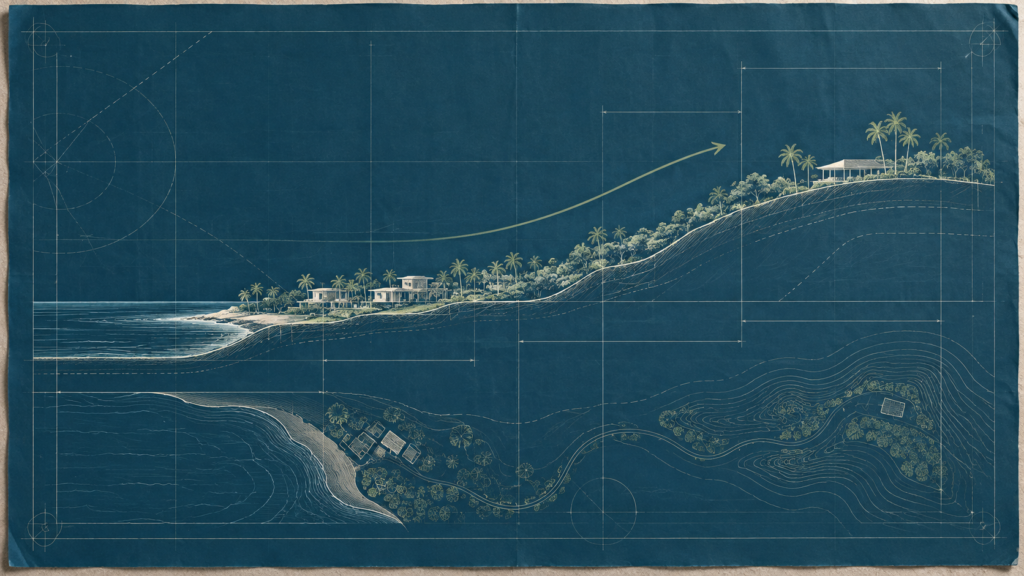
This is where the mathematical asymmetry of the Dauin ridge line becomes an undeniable asset play. Clean, titled freehold land plots overlooking the Dauin coast trade at an institutional market baseline of $25 to $70 psqm (₱1,300 to ₱4,000 psqm).
Premium parcels on a 125-meter elevated ridge, fully integrated with paved access roads and main-line utilities, routinely exchange at a modest $35 to $40 psqm (₱2,000 to ₱2,300 psqm).
For cross-border comparisons, land valuations sit as follows: Bali (Ubud/Uluwatu Ridge) ranges from $150 to $600 psqm under leasehold; Siargao (Cloud 9 Hub) is around $440 psqm freehold; Panglao averages $120+ psqm freehold; while the Dauin elevated ridge offers freehold titles at just $35 to $40 psqm.
This dramatic value gap yields three distinct financial protections for project partners.
First, downside insulation is achieved by acquiring a permanent, non-expiring freehold asset at an emerging market price floor, minimizing capital risk from day one.
Second, CapEx concentration is optimized because land acquisition consumes a small fraction of the total capitalization, letting development funds be deployed entirely into vertical luxury assets.
Third, a finished luxury ridge villa in Dauin commands rental rates competitive with Panglao or Siargao due to its views of the Apo Island Marine Sanctuary, but operates on an accelerated capital payback timeline due to the low land cost basis.